

Why does the lowest upfront price so often cost more over time?
Upfront price is the number everyone sees. It is rarely the number that matters most. A project's capital construction cost is paid once, while its operating and maintenance costs are paid every year the facility stands.
That imbalance is where budgets quietly go wrong. A lower-specification envelope, a less efficient mechanical system or a finish that wears quickly all trim today's invoice. Each one also adds to the cost of running the facility for decades.
When bids are compared on price alone, only the first chapter of the cost story is on the table. The rest arrives later as energy bills, repairs, downtime and early replacement, and by then the decision has been made.
We ask you to look at the whole ownership period before design is fixed. That is when a change costs the least and protects your long-term investment the most.
What does total cost of ownership actually include?
Total cost of ownership: the full cost of a facility over its useful life. It covers building it, operating and maintaining it, adapting it as needs change, and eventually replacing or disposing of it. Life-cycle cost analysis is the method used to compare design options on that basis.
Total cost of ownership covers every cost a facility generates, from the first day of design to the last day of use. It is more than a longer version of the budget.
Four categories carry most of the weight: capital construction cost, energy and utilities, maintenance and repair, and the cost of adapting the space as your operations change. Each responds differently to design decisions, which is why they belong in the same conversation.
The comparison works best early. Options that meet the same performance requirement but differ in capital and operating cost can only be compared fairly while the design is still open. Value engineering and lifecycle cost optimization are part of how we work with you during pre-construction.
Where does the trade-off usually break a project budget?
It usually breaks in one of two places. The first is late, when a design has been priced and someone has to find savings. The second is early, when the lowest-priced option is chosen because nobody modelled the alternative.
Value engineering done late tends to remove capital cost without asking what it does to operating cost. Done early, it does the opposite. It tests each option against the whole ownership period and keeps what earns its place.
Timing matters more than technique. The same question produces a different answer in pre-construction, while systems and materials can still be chosen freely, than it does at tender.
That is why we get involved during design rather than waiting for finished drawings. Constructability, budget and sourcing are shaped before a shovel goes in the ground, through the integrated approach described in our white paper.
What did this look like on the Dicom project?
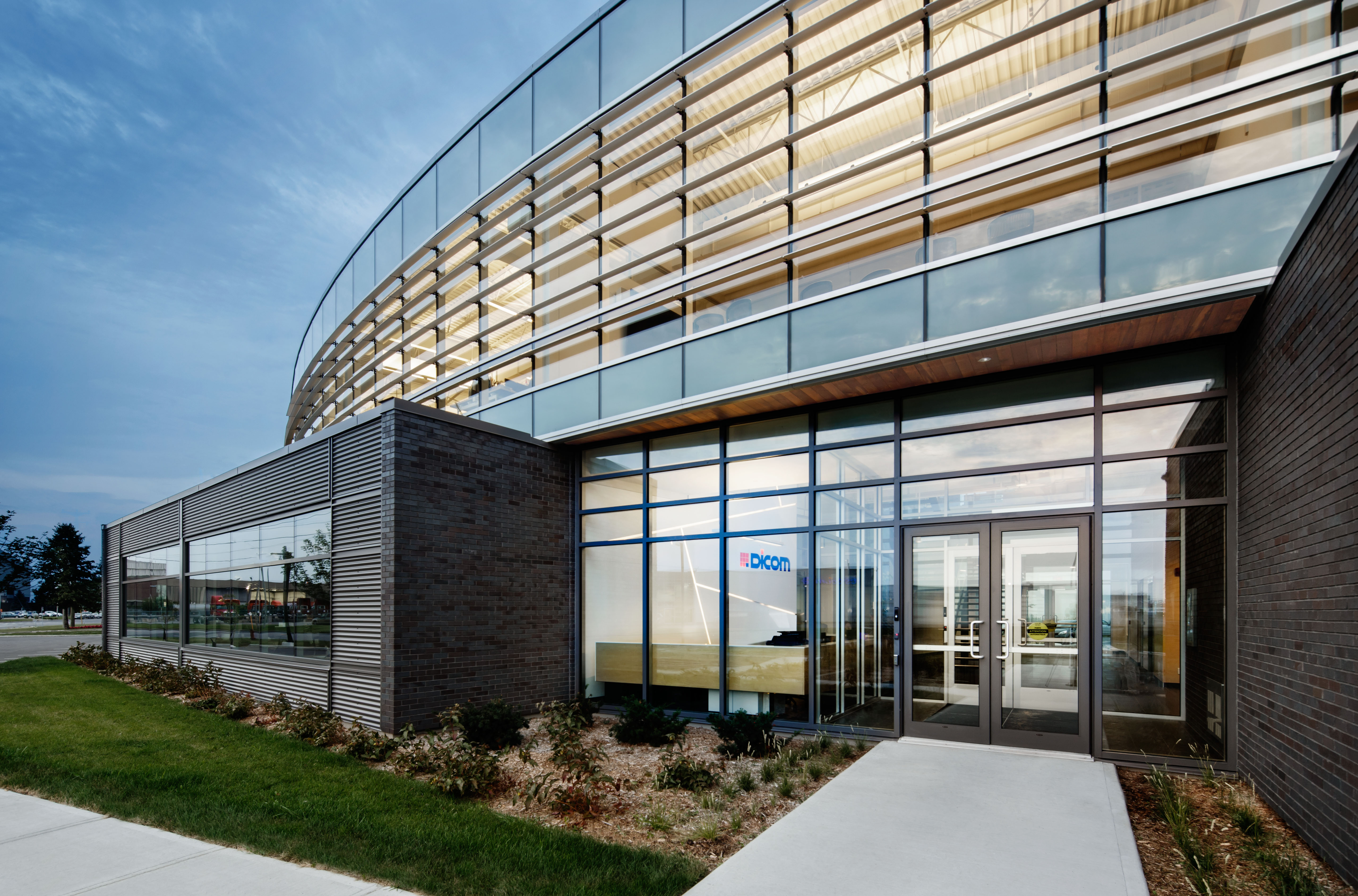
On the Dicom HQS project, we worked with Dicom's staff and professionals from pre-construction so the design stayed cost-effective and reflected their current and anticipated needs. The project achieved LEED Canada Gold certification, awarded through the Canada Green Building Council.
"Our LEED Gold certified building was delivered on time and under budget expectations."
Scott Dobak, CEO, Dicom Transportation Group
For us, certification is one lever within lifecycle cost management, not a separate campaign. Our process runs through commissioning and certification follow-up, so the outcome you approve at the start is the outcome you receive at close-out.
What should you weigh before choosing on upfront price?
Agree the period. Decide the ownership horizon you are comparing, for example 20 years, before bids arrive.
Compare like for like. Set options against the same performance requirement so differences in capital and operating cost are visible.
Involve the builder in design. Systems and materials can still change at this stage.
Ask about handover. Commissioning, warranties and certification follow-up belong in the scope.
Ask for proof. Named projects and client references show how the approach performed.
If you are weighing an industrial, commercial or institutional project, we are glad to walk through your options with you. We partner with you from pre-construction through close-out, so the decision you make at the start still holds at the end.